Tuesday, August 28, 2012

Textual criticism

It sounds like someone is complaining about the text. It's actually the process of comparing different copies in order to discover the original wording. It's very useful for everything from folios of Shakespeare, clay tablets about Gilgamesh, to parchments and codices of the Bible.

Some of  the rules a text critic follows:
  • old manuscripts tend to be closer to the source
  • briefer texts are more probable than longer ones because a scribe is more likely to add an explanation than subtract unless they deleted a controversial passage
  • bad grammar and ugly writing are more likely to be original
  • the writer's style is like their fingerprint and so critics can see interpolations by others

Text critics often compile an "eclectic edition" using a collection of various source documents and then others can use that for their own work in translation. There is an eclectic edition of Greek New Testament texts called the Nestle-Aland that many modern Bible translators consult. It contains notes on variants in the source documents and why one reading or interpretation was chosen over another.

Wednesday, August 22, 2012

God said it

I thought to myself last night that if I believe that Jesus can be trusted, then if He quoted from the Old Testament, that adds to those writings' reliability. Yes, I know people can argue with that. It just reminded me of that phrase, "God said it, I believe it."

Saturday, August 18, 2012

Here's a Quick Way to Choose a Bible Translation

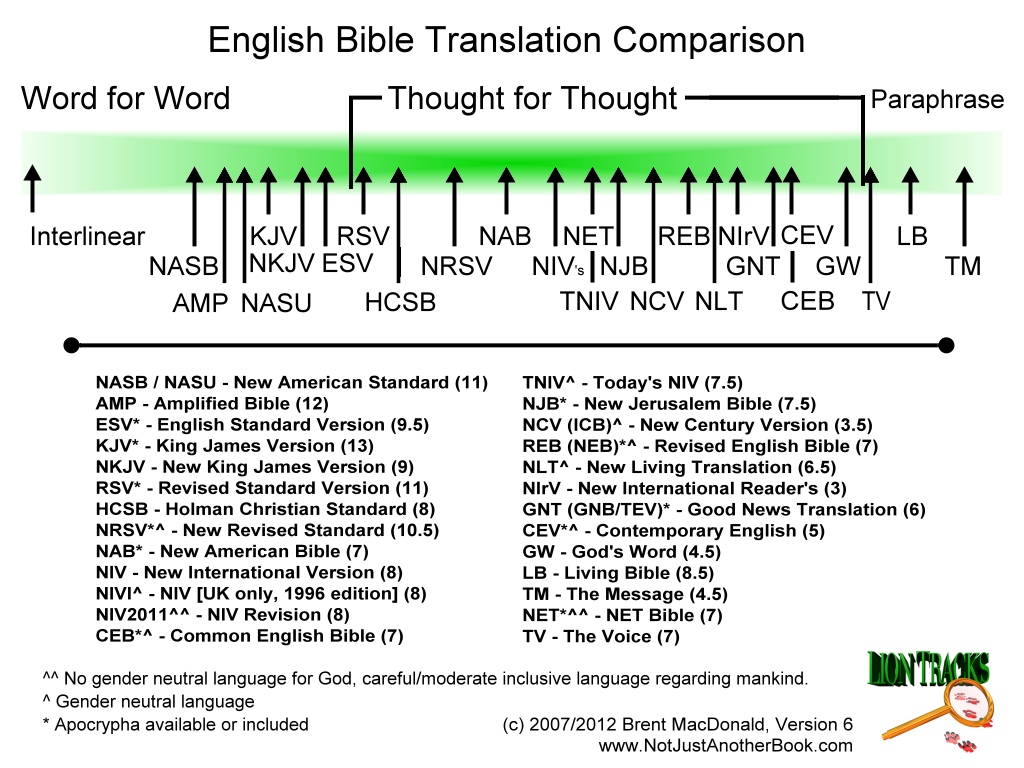
Here is a very nice visual comparison of popular English Bible versions available today. The site itself from whence this image comes has details about what the chart means. For instance, the number in parentheses is the suggested grade level for reading that translation.  I see that my NIV falls into the 8th grade category. King James is at a college level. The NRSV that the pastor uses is designated tenth grade level.

The chart also notes which translations use "gender neutral language." For example, the NRSV uses "humankind" when talking about the creation in Genesis 1. Someone pointed out that applying gender to God is an old-fashioned concept. This is yet another thing for my mind to get used to thinking after all those years of calling God "Heavenly Father."

The same website mentioned above also has a graphic showing how many people were involved and what year these modern translations were finished. For example, only one person worked on The Message, my current reading Bible, and it was complete in 2002. I know from reading the preface to The Message that Eugene Peterson, the man who translated it, took ten years to finish it.

The first version of the NIV was done in 1978 and 110 people helped make it. The NRSV was done in 1989 after 30 people worked on it. You may already know that the King James Version was done in 1611, but did you know that the New King James Version was finished in 1982 after more than twice the number of original KJV scholars worked on it?

If you are looking for a new Bible or trying to decide which one to give to someone, I can tell you these things--if you don't have a bookstore that carries a large selection, try Amazon.com or ChristianBook.com because they both have book previews.  Sometimes Google Books does also. When you are trying to choose, it can get tricky because there are so many versions. My friend on the bench the other day was dead set on having the words of Christ in red and a concordance. Most translations offer a concordance, but not all have the text attributed to Jesus in red. This may be because not everyone thinks it's exactly word-for-word what He said. As I read somewhere, ancient historians were more concerned with getting the gist correct.

A person can get caught up in the politics of which translation is aimed at more liberal readers or more conservative readers. I don't know enough to worry about that yet. I have a translation by a gay college professor and I really like it. It was the second Bible I bought. In fact, I recommend having more than one version. You can achieve that by buying a parallel Bible with two or more translations in one book. I suppose that after those decades of close-mindedness I can't help but feast on the variety out there.

Friday, August 17, 2012

In the language of the people

I sat for a while on a bench with a friend who was perusing a catalog of Bibles for sale. A Mormon colleague from my office stopped to chat. As soon as she realized what kind of catalog it was I saw her reaction of rejection. I jokingly asked if she would like to get one, perhaps a newer translation, but she quickly said no, it was too modern for her.

I understand her reaction--there but for the grace of God that would be me, distrustful of the unknown, sure in my beliefs, thinking I didn't need anything more. In fact, my first Bible purchase as I left the LDS church was a King James Version. I felt safer with that.

Now that I have spent time with other versions of the Bible, I have found there are some that I enjoy very much. I have a study bible that uses the NIV, New International Version, translation. I enjoy it because it is clearly written in modern language.  Please compare:

Joshua 6, King James Version (KJV)
Now Jericho was straitly shut up because of the children of Israel: none went out, and none came in.
2 And the Lord said unto Joshua, See, I have given into thine hand Jericho, and the king thereof, and the mighty men of valour.
3 And ye shall compass the city, all ye men of war, and go round about the city once. Thus shalt thou do six days.
4 And seven priests shall bear before the ark seven trumpets of rams' horns: and the seventh day ye shall compass the city seven times, and the priests shall blow with the trumpets.
Joshua 6, NIV (1984)
  Now Jericho was tightly shut up because of the Israelites. No one went out and no one came in.
2 Then the Lord said to Joshua, “See, I have delivered Jericho into your hands, along with its king and its fighting men.  
3 March around the city once with all the armed men. Do this for six days.  
4 Have seven priests carry trumpets of rams’ horns in front of the ark. On the seventh day, march around the city seven times, with the priests blowing the trumpets.
I keep hearing and reading that the Lord spoke in the tongue of the common people so he would be understood. The KJV was the tongue of the common person 500 years ago. My personal opinion is that if Jesus came today I wouldn't hear him talking like Shakespeare.


Tuesday, August 14, 2012

Magic bullet

One by one, I am revealing to my LDS friends that I am now a Christian. I told another one yesterday. There was no drama.  I'm not certain she even flinched, at least not outwardly. We discussed some key differences between Christianity and Mormonism, such as being saved by grace or saved by grace and works. It was a civil discussion, just as I'd expect from my well-educated and kind friend.

What is breaking my heart since then is that she said she is totally content with her beliefs and content to let others believe as they want. Key word: content. Synonym: at ease, comfortable, complacent.

God gets to us when we are not content. My eyes were wedged open because of the controversy over marriage equality. When I watched the Youtube video conversion stories of the members of the Adams Road band, one pointed out that he read the Bible as a missionary to prove a Christian minister wrong and then saw the doctrinal conflicts with LDS scriptures. Another friend of mine was offended by cultural differences between the members from his home state and the ones in Utah. Each person that left Mormonism can probably tell you what took them out of the drone zone, made them consider what they'd always accepted as being unacceptable.

If you are waiting to help a Mormon open their eyes, don't be afraid if they have a trial.  Get ready to support them. It could be the magic bullet to wound them with the truth so they can heal in God's grace and love.

Saturday, August 11, 2012

God has nothing to hide (The Bible is Reliable, part 3)

I mentioned before that I read, and yes, enjoyed, the Book of Mormon.  I knew all the stories, I memorized verses.  Like every good Mormon, I prayed to know if it was true. I admit I never had the "burning in the bosom" I hoped for, but I still told everyone how great the book was because I really believed it and wanted, some day, to feel it. I thought something was wrong with me, that I just didn't have enough faith yet.

LDS missionaries and members tell everyone to pray about the Book of Mormon to know if it's true.  They do not tell people to compare it to the Bible (although they do highlight the part where Jesus supposedly visits the Americas, perhaps because it copies the Sermon on the Mount and sounds Biblical).  They avoid discussions of archaeological support.  They do not advocate deep research into details. And there are no manuscripts from ancient times to use for translation comparison.

So for decades I believed God worked on the principle of blind faith.  WRONG.  God has nothing to hide.  He is perfect. He understands us, His creations.  He provides lots of evidence and His work can withstand scrutiny.

Archaeological evidence for the Book of Mormon: ZERO.

Archaeological evidence for the Bible: peruse the local library, the Internet, scholarly journals, and expect to spend a long time absorbing it all.

Manuscript evidence for the Book of Mormon: only the documents Joseph Smith and his scribes wrote, along with various editions and corrections of the Book of Mormon, from the 19th and 20th centuries.

Manuscript evidence for the Bible: I've only touched on the Old Testament so far in prior posts; wait till I get to the New Testament.  LOTS.

God invites us all to research His work for ourselves.  He provides confirmation for our minds and hearts.

Acts 17:11, New Living Translation (italics mine)
And the people of Berea were more open-minded than those in Thessalonica, and they listened eagerly to Paul’s message. They searched the Scriptures day after day to see if Paul and Silas were teaching the truth.


Thursday, August 9, 2012

Three decades dedicated

I read an article today about a man in Israel who spent thirty years correcting 1500 errors in the Old Testament. Here's what one part of the article said:
The errors have no bearing on the Bible's stories and alter nothing in its meaning. Instead, for example, in some places the markers used to denote vowels in Hebrew are incorrect; or a letter in a word may be wrong, often the result of a centuries old transcription error. Some of the fixes are in the notations used for cantillation, the text's ritual chants.
I found that encouraging since I've been writing about the reliability of the Bible.